Igor Shakhanov is an independent researcher working at the intersection of philosophy of mind and the foundations of transhumanism. His central project, Causa Sui, develops a working theory of subjecthood grounded in the irreversibility of a substrate's physical state — arguing that deterministic digital architectures are structurally incapable of the kind of subjectivity that living substrates instantiate.
Recent work extends this line of inquiry into the philosophical literature on mind uploading and personal identity, examining an assumption shared by both proponents and critics of digital immortality: that a digital system is capable of being a subject in the first place.
Read more about Project Causa Sui, in plain language: English · Русский
Subjectivity Before Personal Identity: A Missing Foundation in the Debate on Transhumanism
Argues that the debate on mind uploading — including Ralph Weir's influential critique of transhumanism — presupposes that a digital system can be a subject, without establishing the conditions under which this holds.
Project Causa Sui: A Minimal Architectural Theory of Subjecthood
Condensed academic version of Part I: genuine subjectivity arises from the irreversibility of a substrate's physical state, not from computational complexity — the foundational argument in compact form.
Project Causa Sui: A Carrier Criterion for Subjecthood, Applied to Transhumanism
Condensed academic version of Part II: transhumanism formulated a goal without a rigorous mechanism to reach it — this excerpt sets out the mechanism in compact form.
Project Causa Sui, Paths of Implementation — The Mechanism of the Subject, a Simulated World, and a Falsifiable Prediction
Summary of Book Three: Postulate 1 in a strict form (P1*) with respect to a causally closed boundary; the mechanism of the subject as a hierarchy of graphs and matrices, with irreversibility located in the graph; a simulated world in which the mechanism was made to work; and a prediction for living neural tissue, recorded in advance.
Succession of a Subject at a Distance: What Is Transmitted and What Is Grown
A subject cannot be sent, but it can have a successor at any distance: matrices and the growth program travel over a channel, while the graph is grown on the spot — at the time of transfer or in advance. Transfer is not restore; the source need not perish, and the chain of successors becomes a tree. The strict version of the essay “Is Teleportation Real?”.
Is Teleportation Real? What Travels and What Grows: Succession of a Subject at a Distance
Science-fiction teleportation assumes the very same person arrives at the other end, and that is what makes it a utopia. The theory of Causa Sui separates what in a subject can be transmitted (its content: knowledge, memory, skills) from what can only be grown (the living structure that binds it together). Hence a more honest teleportation: a carrier is grown on the spot from a transmitted program, the content follows as a signal, and what arrives is a successor whose difference from the original can be estimated and measured.
Expectations Recorded in Advance: Do New Connections Appear When Living Neural Tissue Masters a New Task?
Before any experiment, states what the theory expects from cultured neural tissue and organoids: lasting mastery of a genuinely new task should be accompanied by new stable connections, not only by changes in the strength of existing ones — and names in advance the results that would mean the theory is wrong.
The Simulated World: Program Behind Chapter 32
Program that lives the life of an individual in a simulated world and checks whether the mechanisms of the theory (graphs, matrices, the birth of a new graph in agony) are consistent. Code, data, figures and the algorithm in plain words, in Russian and English.
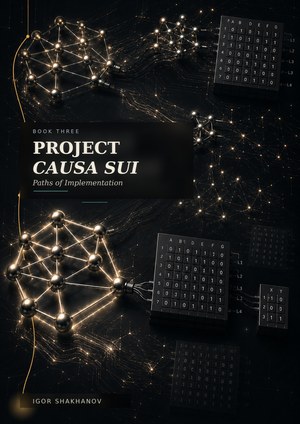
Paths of Implementation
The third book of the project moves from theory toward implementation: a strict form of Postulate 1, the mechanism of the subject as a hierarchy of graphs and matrices, a simulated world in which that mechanism was made to work, and a prediction for living neural tissue recorded in advance.
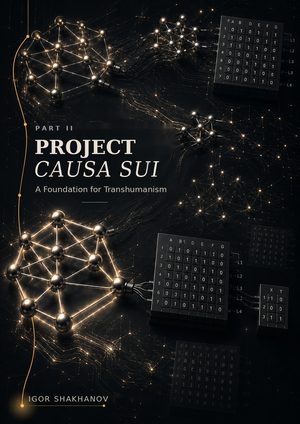
A Foundation for Transhumanism
The second part of the Causa Sui project: transhumanism formulated a goal — the expansion of the space of reachable states — but never a rigorous mechanism for reaching it. This part supplies one.
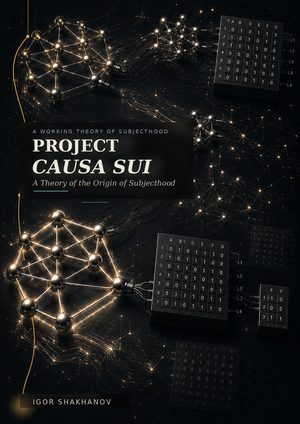
Project Causa Sui
A working theory of subjecthood: genuine subjectivity — responsibility, fear, creativity — arises from the irreversibility of a substrate's state, not from computational complexity.
- ORCID
- 0009-0004-1150-3639
- Amazon Author Page
- amazon.com/author/igorshakhanov
- Location
- Denia, Alicante, Spain
- Affiliation
- Independent Researcher
- Works indexed
- OpenAlex